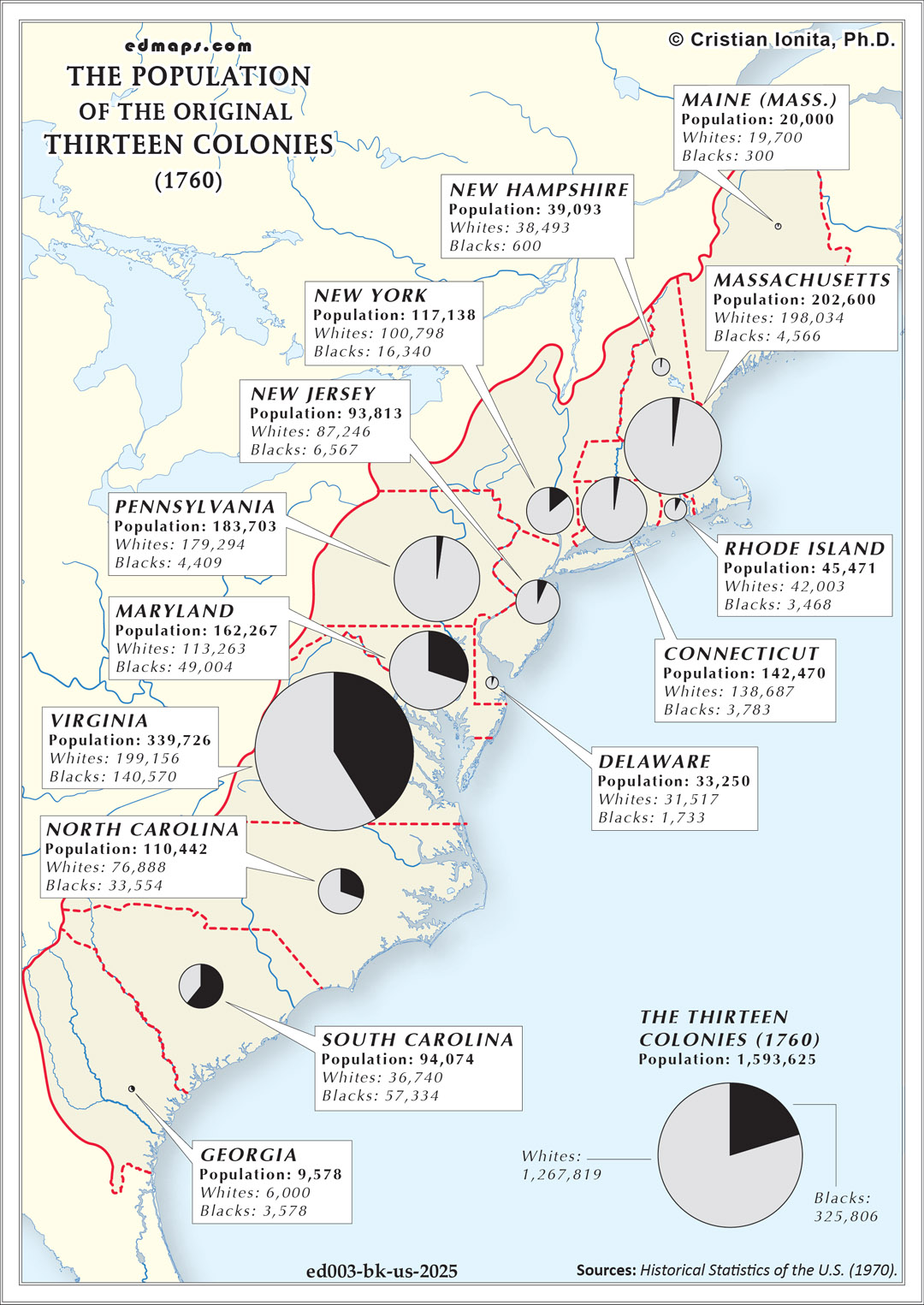
In 1760, the Thirteen Colonies had reached a population of approximately 1.59 million people, representing continued robust growth from the previous decade and positioning the colonies for further territorial expansion on the eve of the French and Indian War's conclusion.
Virginia maintained its position as the most populous colony with an estimated 340,000 residents, sustained by its thriving tobacco economy and mature agricultural infrastructure. Massachusetts followed with approximately 223,000 inhabitants, while Pennsylvania had expanded significantly to around 184,000 people, continuing to attract substantial German and Scots-Irish immigration. Maryland (162,000), Connecticut (142,000), and North Carolina (110,000) formed the next tier of major population centers.
New York contained roughly 117,000 residents, while South Carolina and New Jersey had nearly identical populations of approximately 94,000 and 94,000 respectively. Rhode Island (45,000), New Hampshire (39,000), Delaware (33,000), and Georgia (9,600) represented smaller but steadily expanding populations. Georgia, despite being founded in 1733, remained the least populous colony but had nearly doubled its population since 1750.
The colonial population remained ethnically heterogeneous, with English colonists constituting the largest single group but representing less than half the total population. Substantial immigrant communities included Germans concentrated primarily in Pennsylvania and the backcountry, Scots-Irish settlers dispersed throughout frontier regions, Dutch populations in New York's Hudson Valley and New Jersey, and French Huguenots integrated into South Carolina's coastal society and other colonies.
Approximately 326,000 enslaved Africans and their descendants comprised roughly 20% of the total colonial population, marking an increase from the previous decade. The highest concentrations persisted in the Chesapeake region (Virginia and Maryland) and South Carolina, where plantation-based agriculture created sustained demand for enslaved labor. South Carolina maintained its black majority population, with enslaved people constituting over 60% of the colony's inhabitants.
Colonial urban centers remained modest in scale compared to European cities. Philadelphia had grown to become the largest with approximately 18,000 residents, followed by New York (18,000) and Boston (16,000). Charleston had emerged as the primary southern urban center with around 8,000 inhabitants. Despite their relatively small populations, these cities functioned as essential commercial ports, cultural centers, and political capitals.
The colonial population continued its pattern of doubling approximately every twenty-five years through sustained natural increase and ongoing European immigration, generating intensifying pressure for westward expansion that would contribute to escalating conflicts with French colonial interests and Native American nations along the frontier.