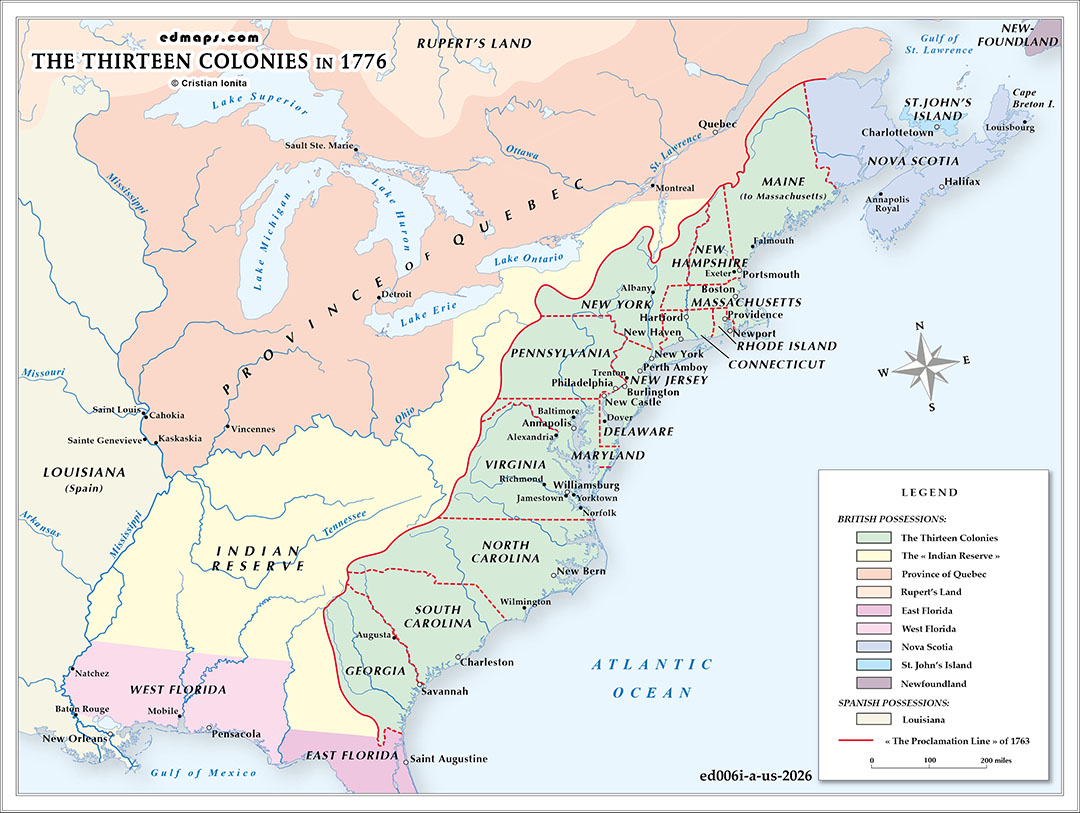
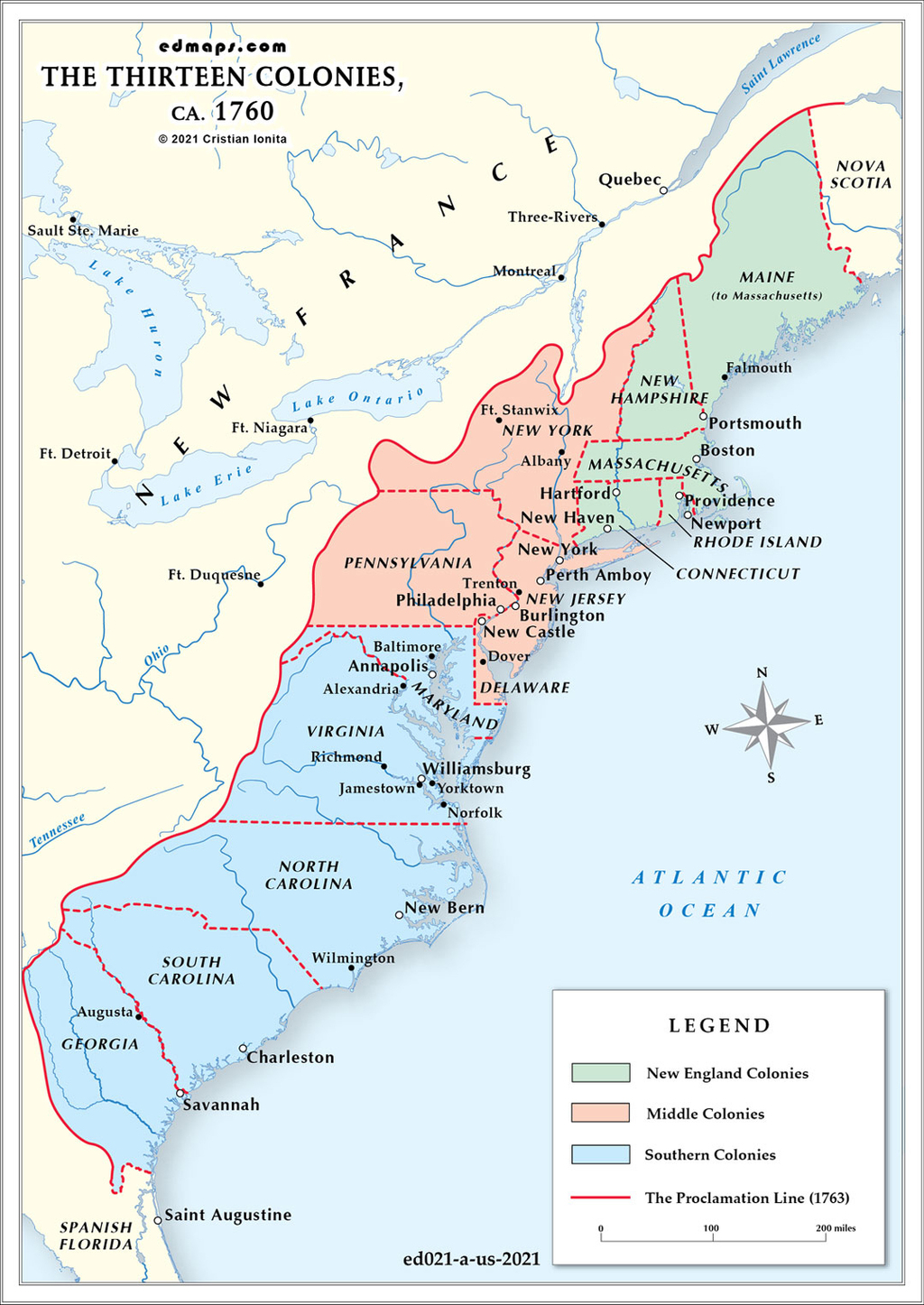
By early 1776, the thirteen American colonies formed a sprawling and heterogeneous set of British possessions undergoing rapid political transformation. Years of disputes over taxation, imperial authority, and territorial limits had eroded the legitimacy of royal governance, leaving the colonial system strained and increasingly unstable on the eve of a decisive break with Britain.
The constitutional landscape of the colonies still reflected their traditional classifications. Royal colonies, such as Virginia, New York, and the Carolinas, continued to operate under governors appointed by the Crown, while proprietary colonies like Pennsylvania and Maryland maintained their chartered privileges under private proprietors. Rhode Island and Connecticut preserved their unusually broad self-governing charters, exercising a degree of autonomy unmatched elsewhere in British America. Despite these differences, all thirteen colonies remained formally subject to parliamentary supremacy and imperial oversight, even as local assemblies asserted growing authority.
Imperial attempts to regulate western expansion remained a central source of conflict. The boundary established by the Royal Proclamation of 1763, intended to stabilize relations with Indigenous nations and control settlement, was widely ignored or openly defied. Colonies with expansive charter claims, particularly Virginia, North Carolina, and Massachusetts, continued to view the Appalachian barrier as an illegitimate constraint on their political and economic aspirations. Land companies, surveyors, and frontier settlers pressed westward, challenging both imperial policy and Indigenous territorial sovereignty.
The reorganization of British North America in 1774 further heightened tensions. The Quebec Act, by extending Quebec’s jurisdiction deep into the interior, was perceived by many colonists as a direct threat to their territorial ambitions and a troubling signal of imperial favoritism toward a Catholic province. Combined with other coercive measures, it contributed to a growing sense that British policy aimed to curtail colonial liberties rather than protect them.
By 1776, the erosion of royal authority was unmistakable. Provincial congresses and committees of safety had supplanted traditional institutions in many colonies, while the Continental Congress, first convened in 1774, was assuming an increasingly assertive coordinating role. Militias were mobilizing, British garrisons were under siege, and parallel systems of governance were emerging across the continent. Even as formal independence had not yet been declared, the political order of the colonies was already shifting toward a new, uncertain configuration.